
This article contains affiliate links. Learn more in our affiliate disclosure.
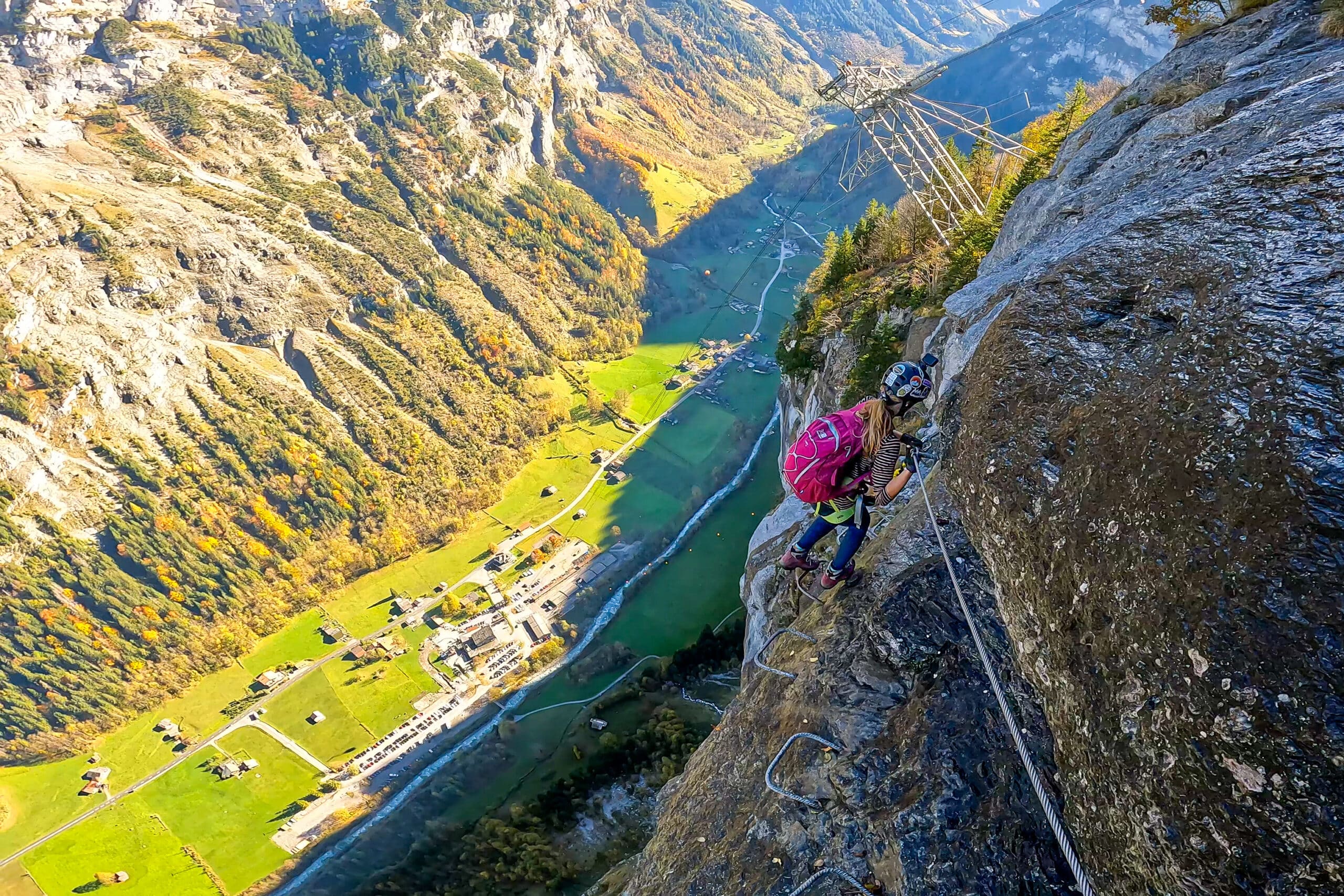
Via Ferrata Mürren was one of the most memorable adventures we had in Switzerland, but it was also more intimidating than we expected. Unlike most via ferratas, this route does not climb towards a summit.
Instead, it descends from Mürren to Gimmelwald along the cliffs high above the Lauterbrunnen Valley.
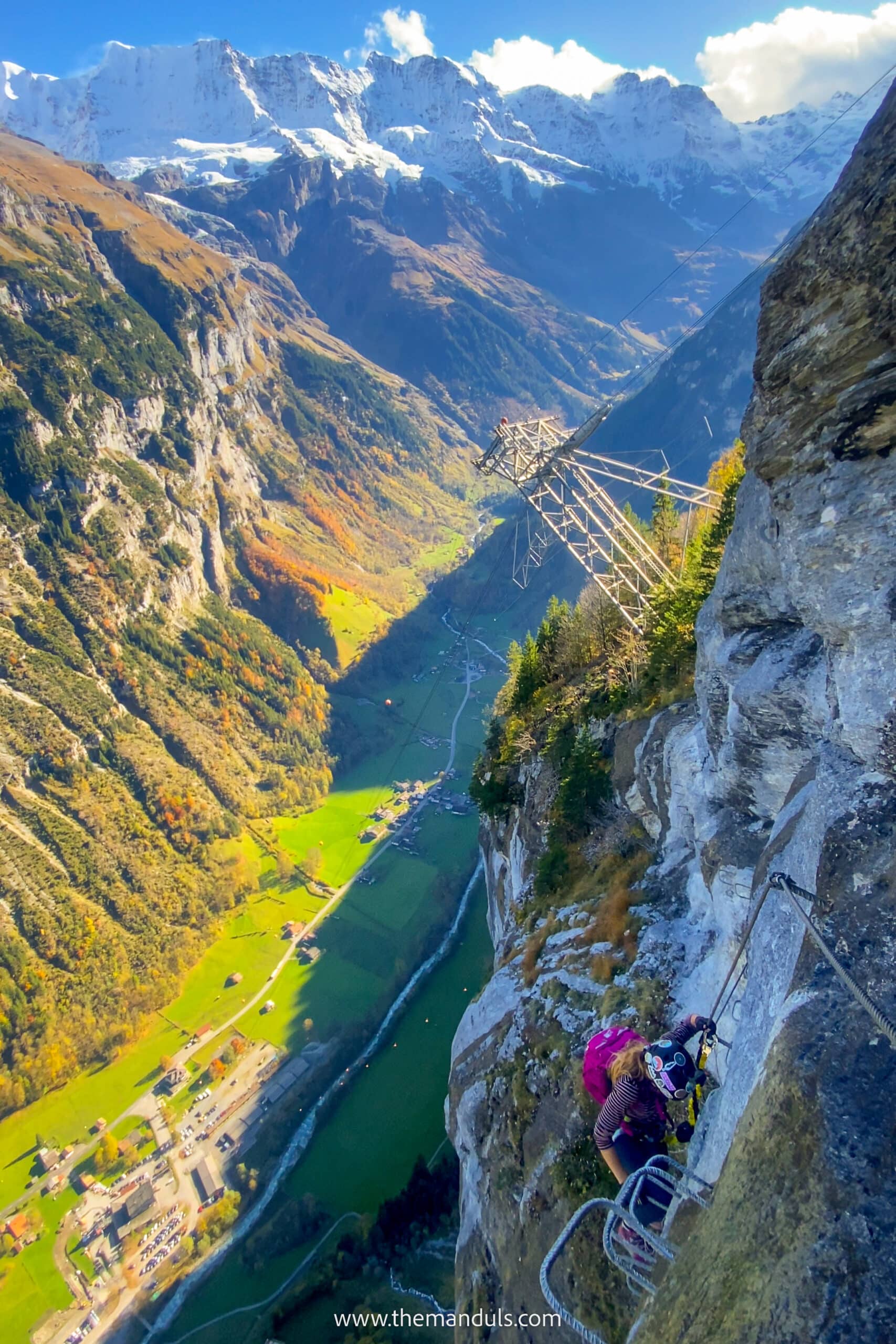
We are usually comfortable with heights, yet the first steps onto the metal rungs with hundreds of metres of open space below us made our knees shake. The route is graded K3, but the rating alone does not fully explain the exposure. The cliff traverse and Nepal Bridge felt much harder mentally than physically.
At the same time, the entire route is not continuously extreme. Longer sections follow forest paths, ladders and easier secured terrain, which gave us time to relax between the exposed highlights.
Based on our experience, we would recommend the Mürren Via Ferrata to sure-footed hikers with a good head for heights and experience using via ferrata equipment.
If this is your first via ferrata, going with a guide is the safer choice.
In this guide, we cover the difficulty, equipment, route, access from Lauterbrunnen and everything else you should know before deciding whether it is right for you.
Key Highlights
⭐️ Starting /Ending point: Sportchalet Mürren / Gimmelwald
⭐️ Time Needed: 3 – 4hours
⭐️ Difficulty: K3 (on a scale K1 to K6)
⭐️ Season: 1 June – 31 October
⭐️ Getting here: cable car from Stechelberg or mountain train from Grütschalp
Is Via Ferrata Mürren Worth It?
Via Ferrata Mürren is worth it if you are comfortable with strong exposure and know how to use the equipment. It is not technically extreme, but the cliff traverse and Nepal Bridge make it mentally demanding. First-timers should go with a guide.
Where is Via Ferrata Mürren
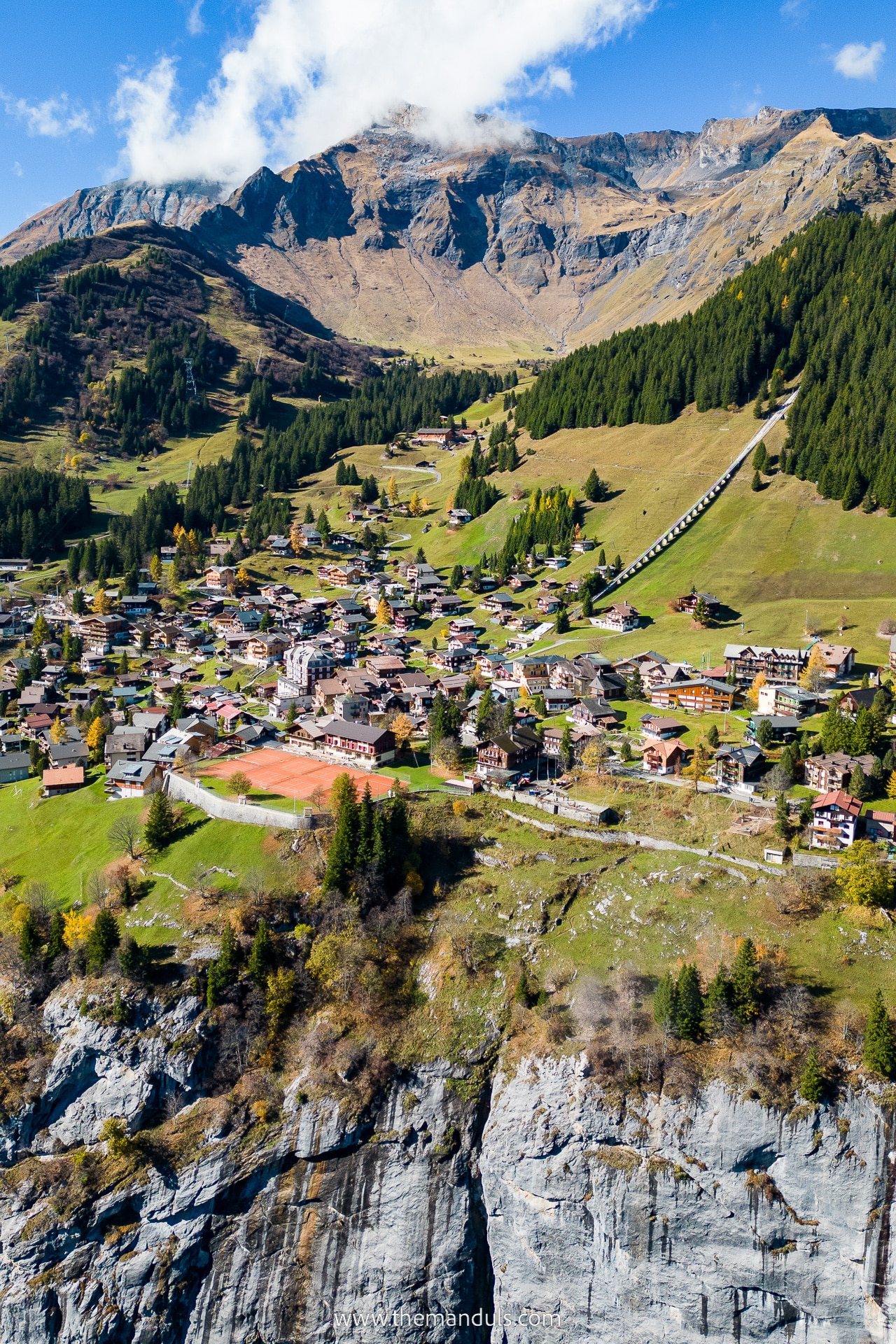
Via Ferrata Mürren runs along the cliffs between Mürren and Gimmelwald in the Jungfrau Region of Switzerland. The one-way route starts in the car-free village of Mürren, at around 1,650 metres above sea level, and descends towards Gimmelwald.
Its location directly above the Lauterbrunnen Valley is what makes this route so unusual. Instead of climbing towards a summit, you move across and down the cliff, with open views over the valley and towards the Eiger, Mönch and Jungfrau.
The route finishes close to the Gimmelwald cable car station, so you can return to Mürren by cable car or continue down to Stechelberg.
How to Get to Via Ferrata Mürren
Mürren is car-free, so the final part of the journey is always by cable car or mountain railway. There are two main routes, but we would now choose the Stechelberg route for the via ferrata because it works better with the one-way finish in Gimmelwald.
From Stechelberg – the easiest option
From Lauterbrunnen, take bus 141 to Stechelberg or drive to the cable car station and park there. The new cable car travels directly from Stechelberg to Mürren, making this route much faster and simpler than it was during our first visit.
It even holds a record of the steepest cable car as of 2026.
A one-way adult ticket from Stechelberg to Mürren costs CHF 11.80 in 2026, or CHF 5.90 with the Swiss Half Fare Card. The journey is fully included with the Swiss Travel Pass and Berner Oberland Pass.
This is also the most practical route after completing the via ferrata. The trail finishes in Gimmelwald, where you can take the cable car down to Stechelberg and return to Lauterbrunnen by bus.
From Lauterbrunnen via Grütschalp
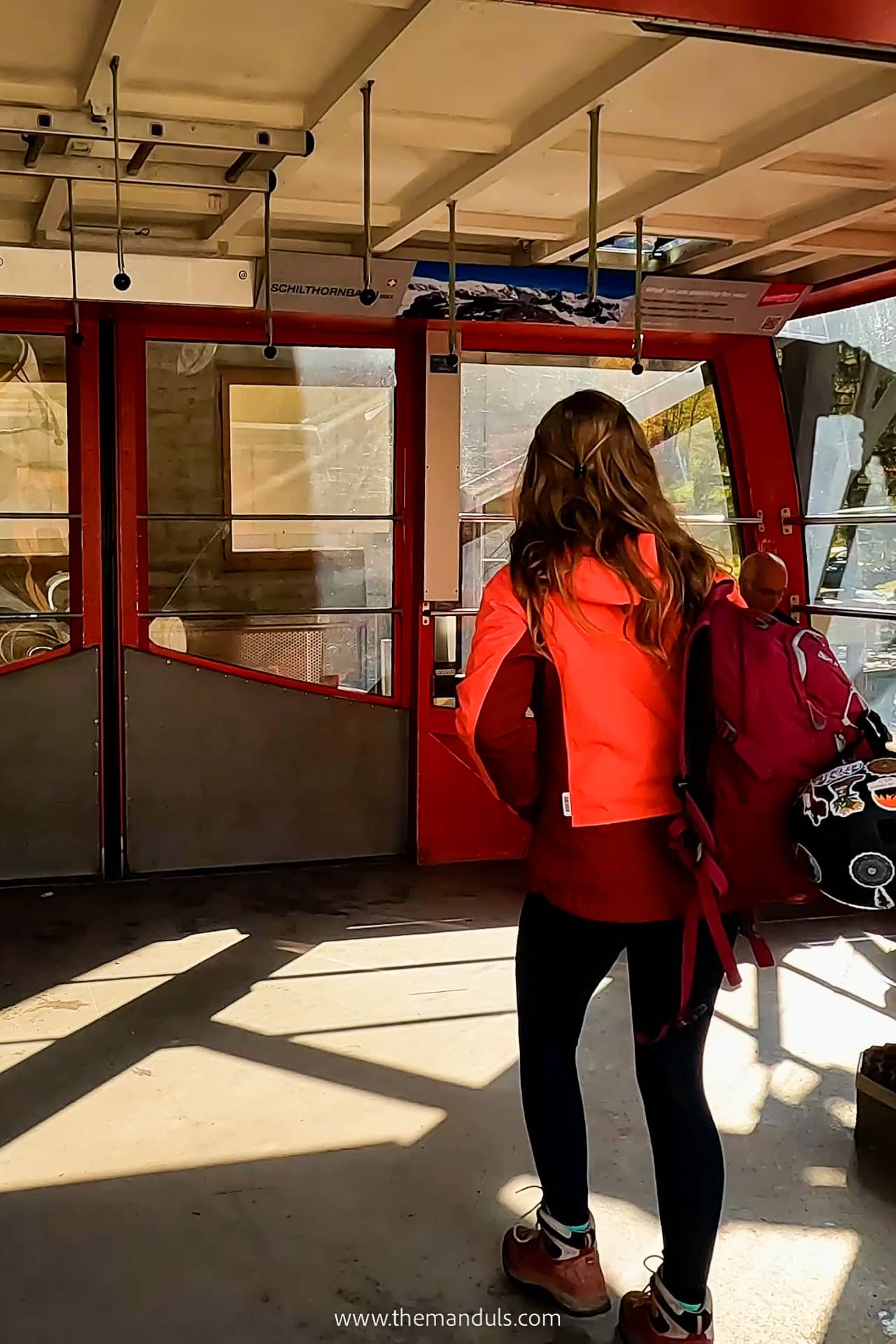
The second option starts opposite Lauterbrunnen railway station. Take the cable car to Grütschalp and transfer to the mountain train through Winteregg to Mürren.
We originally planned to use this route and parked in the large garage beside Lauterbrunnen station. However, it was closed for scheduled maintenance during our visit, so we continued to Stechelberg instead.
The Grütschalp route is more scenic and makes sense if you are already arriving by train or staying near Lauterbrunnen station. However, for the via ferrata alone, the Stechelberg route creates a simpler round trip because the trail ends on the same side of the mountain.
Check the latest connection in the SBB app before leaving. Both routes can close temporarily for maintenance or bad weather.
Check the schedule on SBB.

If you have a Swiss Travel Pass or Berner Oberland Pass all these bus, train, and cable car rides are fully included! Jungfrau Pass covers the Grütschalp route fully.
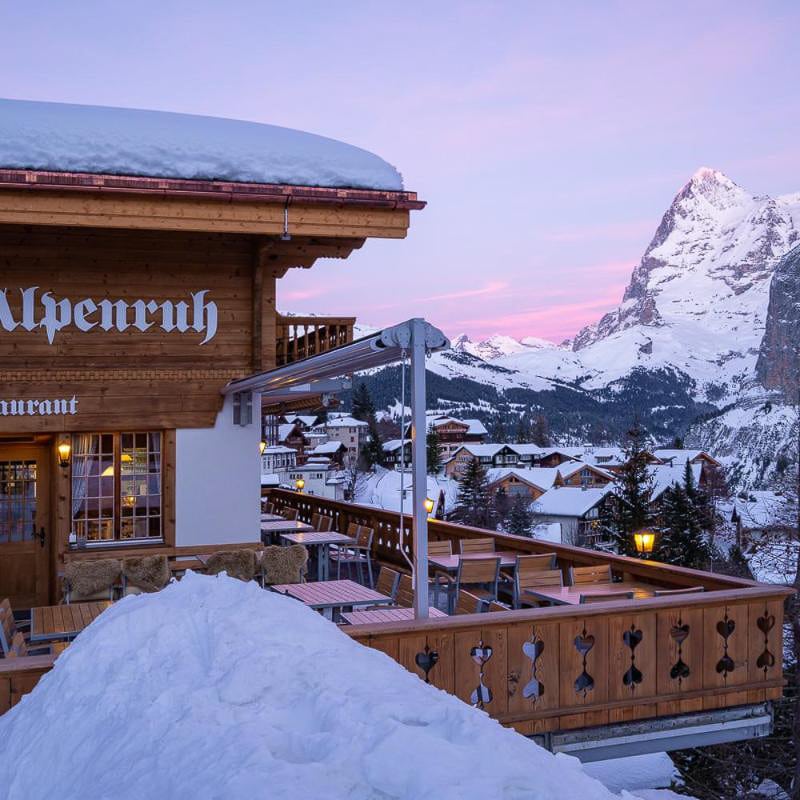
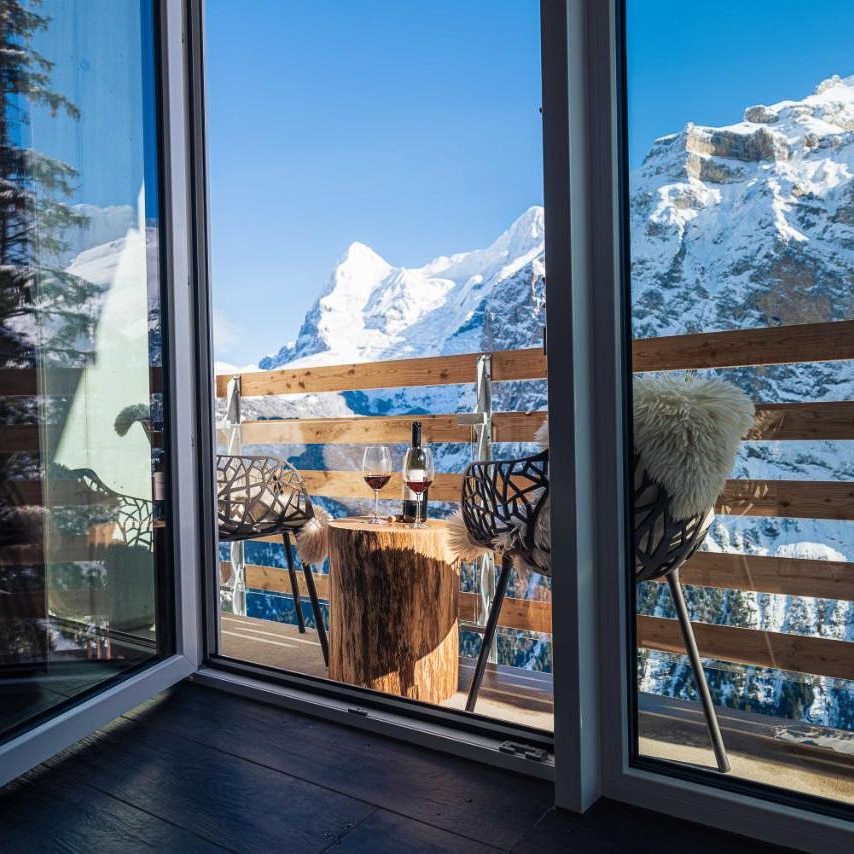
Best hotels in Mürren
Check availability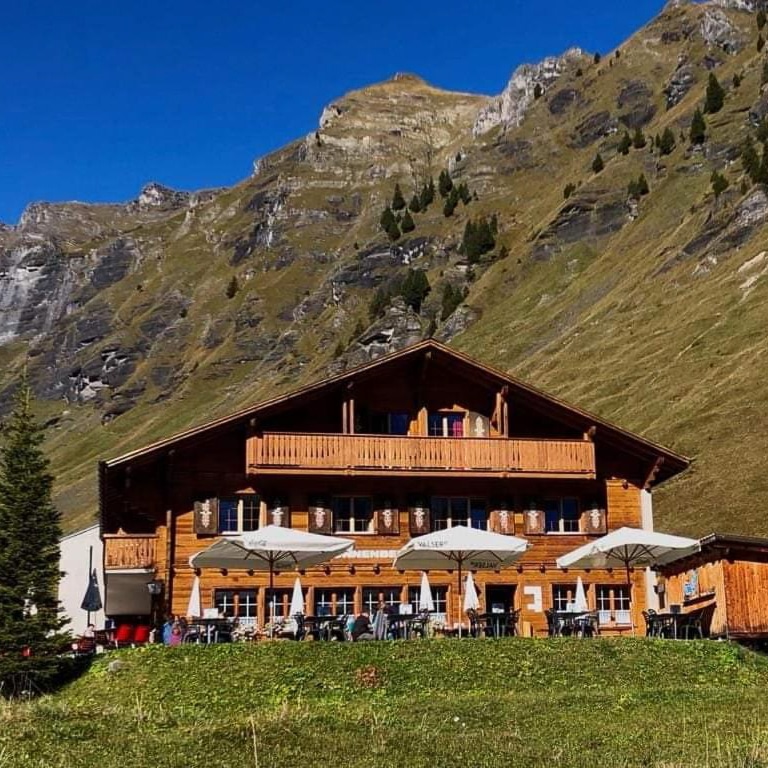
What is via ferrata?
Via ferrata means “iron way” in Italian. It is a protected mountain route equipped with steel cables, metal rungs, ladders and bridges, making it a combination of hiking and climbing.
Via ferratas come in different difficulty levels, and easier routes can be suitable for beginners. However, that does not mean anyone should attempt one without preparation. You still need a reasonable level of fitness, a head for heights and a clear understanding of how to use the equipment.
Being attached to the safety cable also does not make a via ferrata risk-free. If you fall, you may drop past the previous anchor before the energy absorber stops you. A via ferrata fall can therefore cause serious injury even when the equipment works correctly.
Choose a route that matches your abilities, stay clipped to the cable and avoid falling whenever possible. If you have never used via ferrata equipment before, we recommend joining a guided tour or learning the correct technique from an experienced person.
All you need to know

Total time: 3 -4 hours

Distance: 2.2 km

Elevation loss: 300 meters
Difficulty: K3 (medium)
Starting point
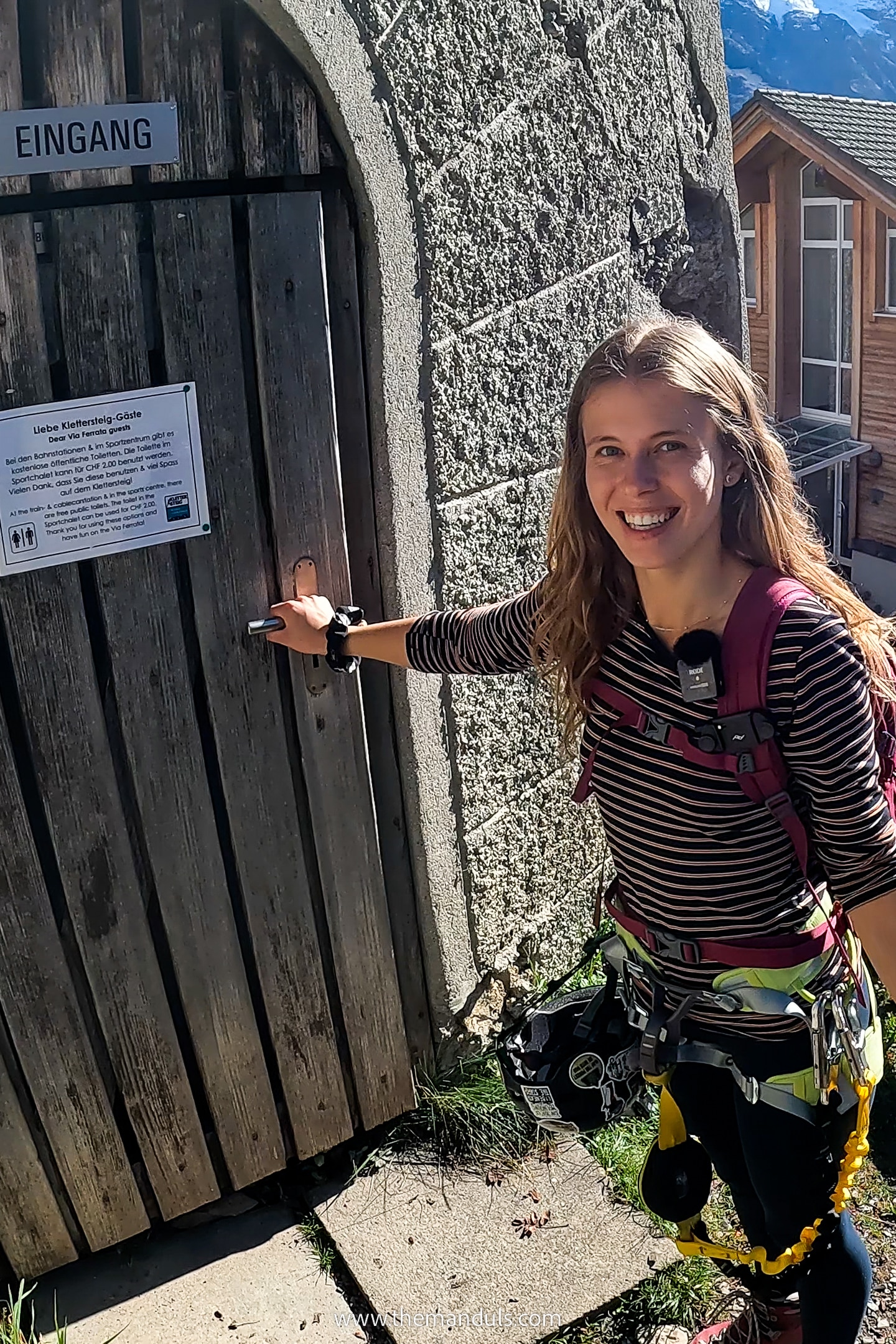
The starting point is located in the mountain village of Mürren. Once we arrived in the village, we could see hiking signposts sending us in the right direction. There is a tennis court on the left. We walked along a narrow dirt path surrounded by a tall stone wall on the left.
Soon, we reached a small tower with a wooden door leading to a short tunnel. This is the official starting point of Via Ferrata Mürren.
This is a one-way route, do not attempt to complete the via ferrata in the other direction (Gimmelwald – Mürren)!
Ending point
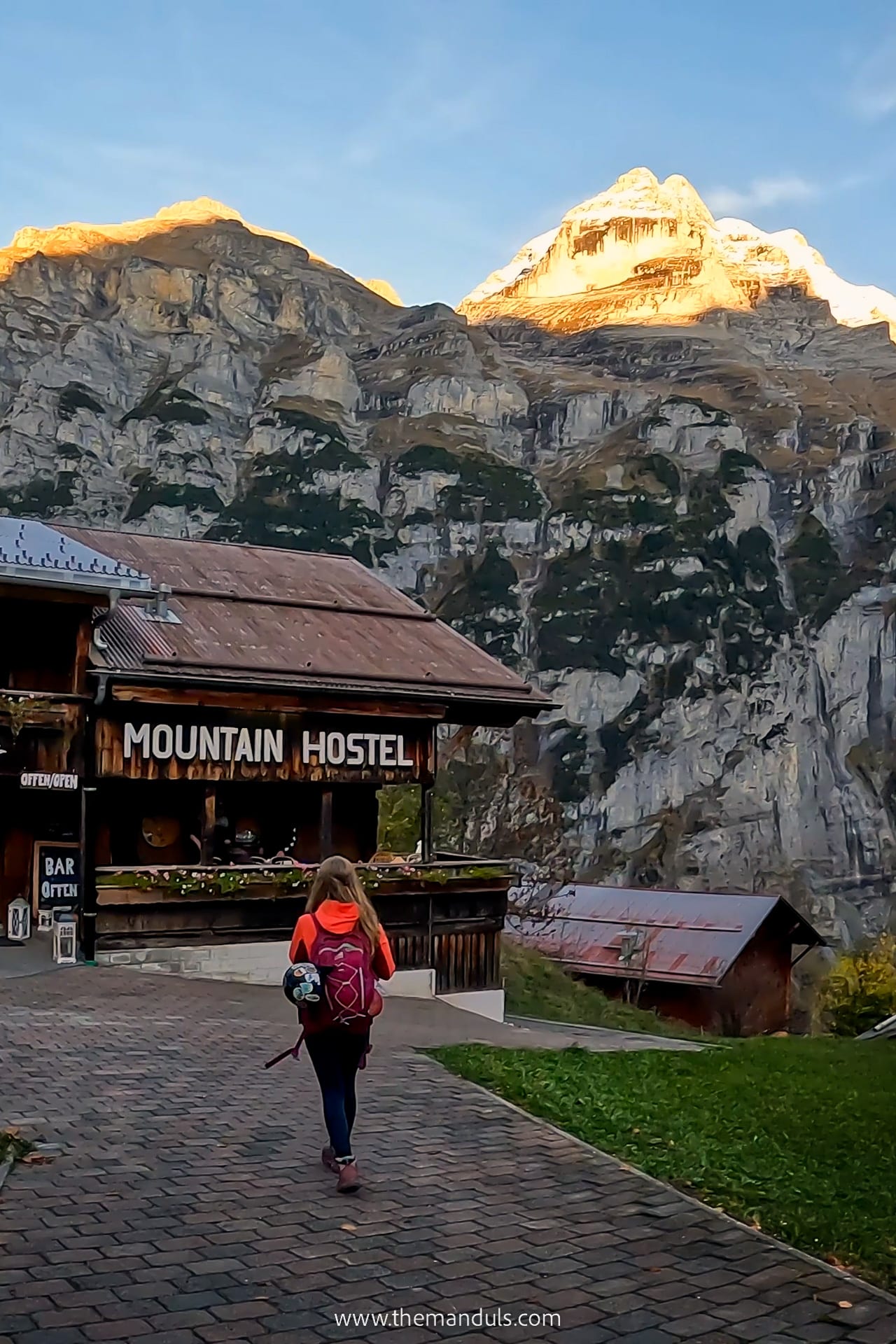
The end is located in a tiny village called Gimmelwald. Once we got out of the forest, we were just a few minutes walk from the cable car station. If you’re staying in Mürren, you can either walk back which takes 45 to 60 minutes) or take a cable car.
Difficulty
Via Ferrata Mürren is rated K3 on the six-grade SAC scale. It is not especially strenuous compared with longer uphill via ferratas, but that does not make it easy.
The route is highly exposed and requires sure-footedness, a good head for heights and confidence using via ferrata equipment.
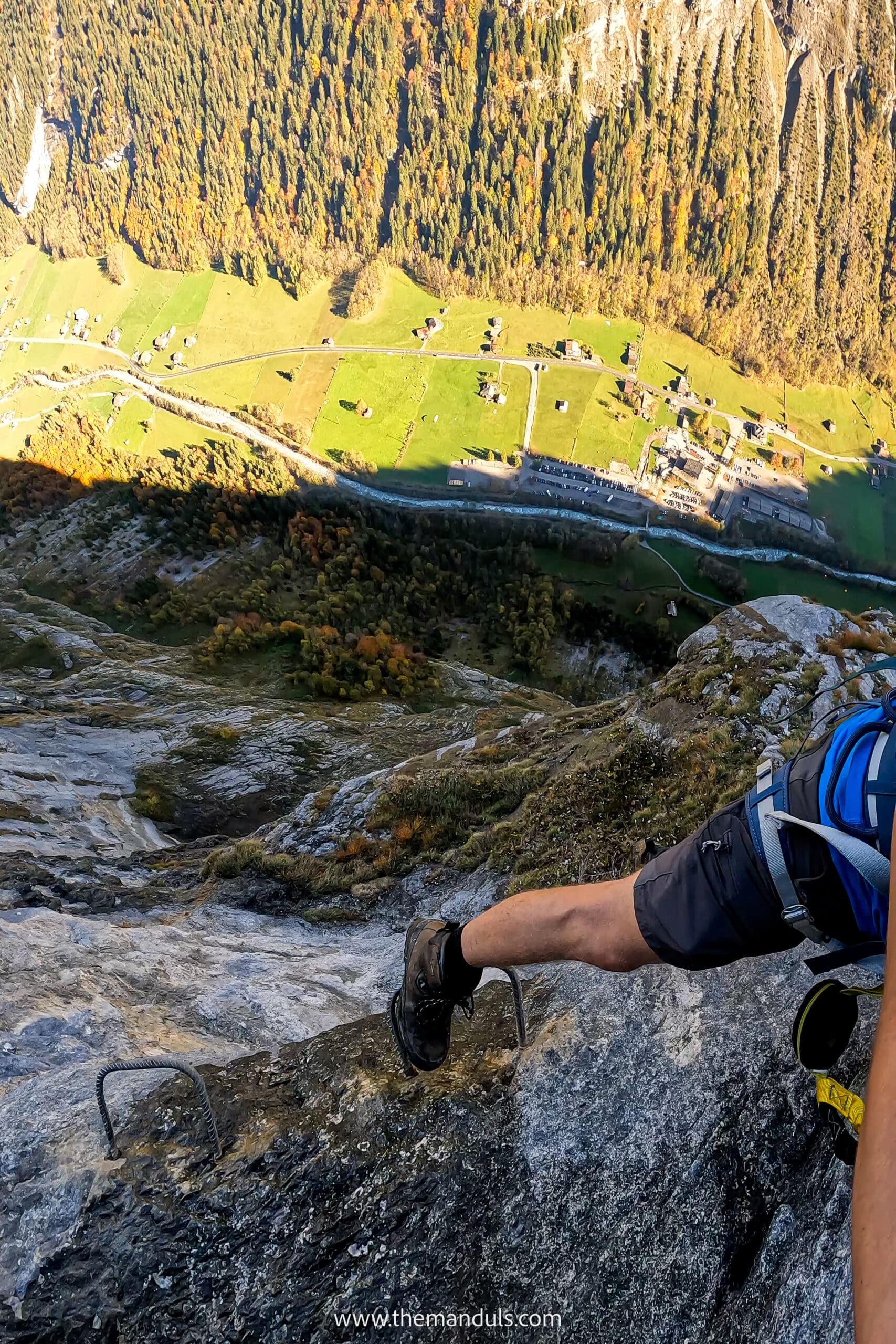
For us, the hardest part was mental rather than physical. The most exposed section follows metal rungs fixed directly into the cliff, with the Lauterbrunnen Valley hundreds of metres below.
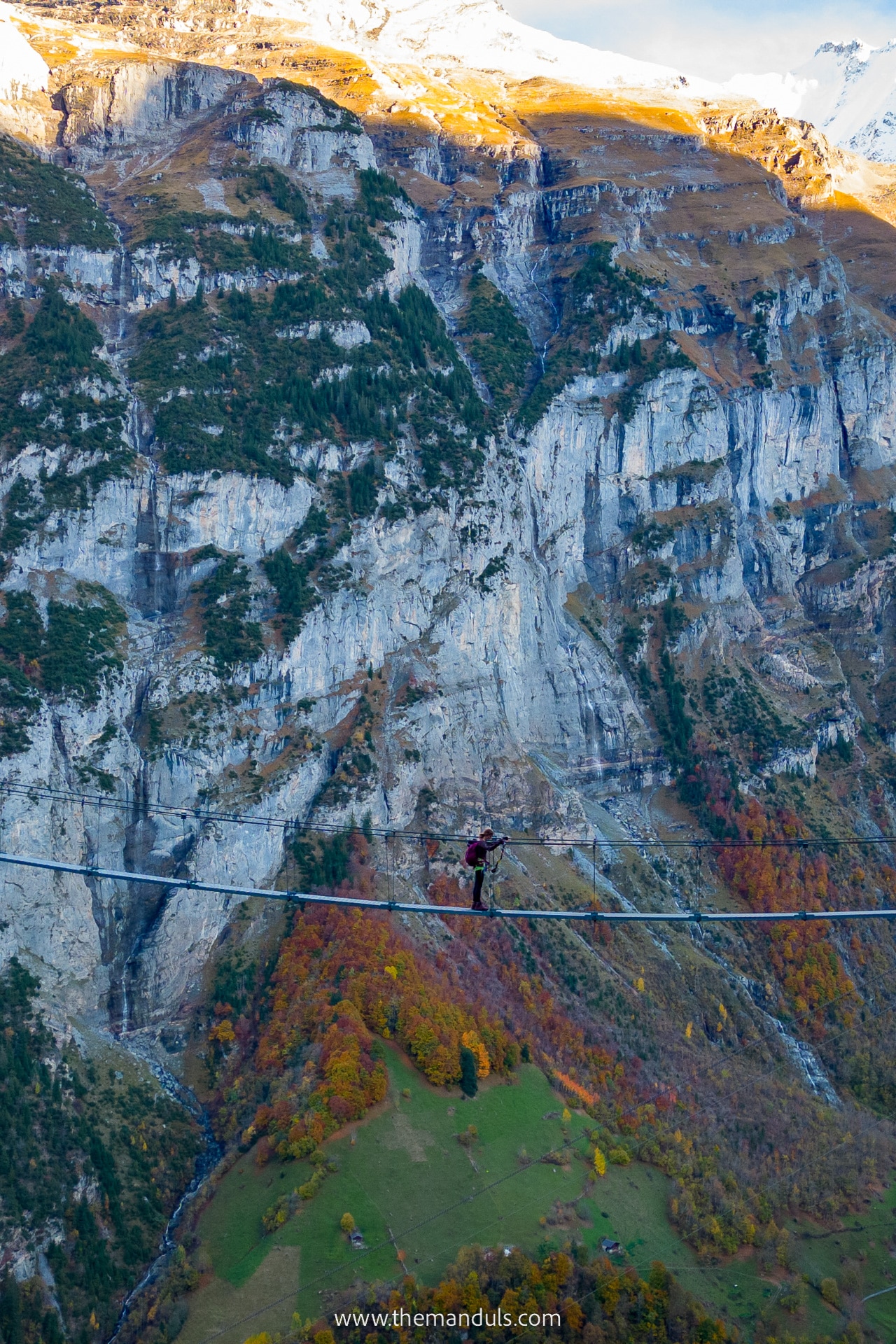
The final Nepal Bridge also moves under your feet and can feel intimidating even if you are normally comfortable with heights.
The route is not continuously exposed. Longer sections pass through the forest, and some feel more like a steep downhill hike. However, the terrain can be muddy and slippery before suddenly returning to ladders, cables or exposed sections, so you still need to stay focused throughout.
Physically, the mostly downhill route is manageable with reasonable fitness, but fitness alone is not enough.
We would only recommend doing it independently if you are comfortable with exposure, know how to use the equipment correctly and can move confidently on steep terrain. If this is your first via ferrata, going with a guide is the better option.
Necessary equipment
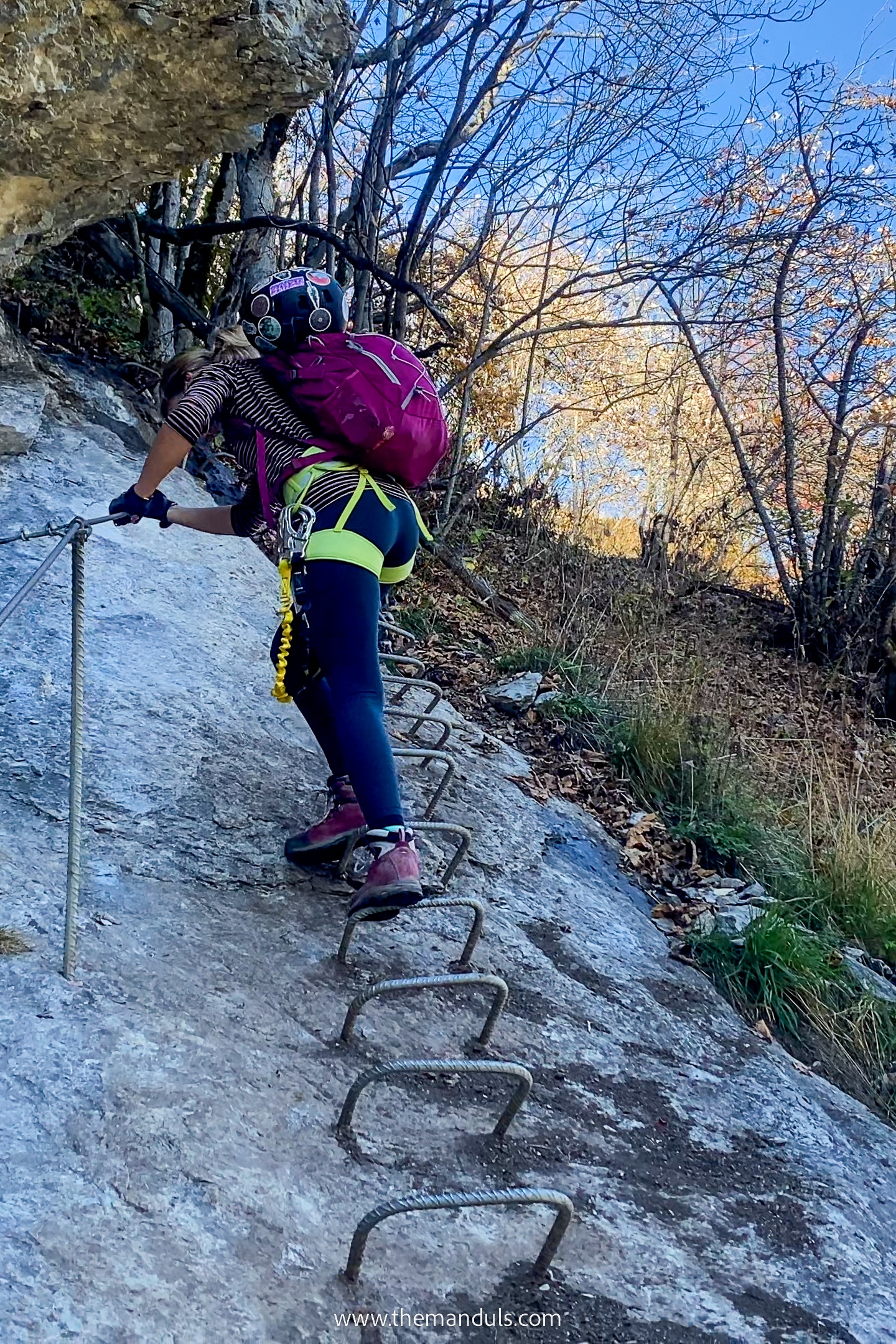
You need a climbing harness, certified via ferrata set with an energy absorber and a climbing helmet. These are essential even though parts of the route feel more like a forest hike.
The helmet protects against falling rocks and accidental contact with the cliff. We bumped our heads against the rock more than once, especially while moving around ladders and tighter sections.
Gloves are optional, but we strongly recommend them. They improve your grip on wet cables and protect your hands during the longer secured sections.
Before starting, check that the harness fits correctly, the via ferrata set is attached to the correct belay loop and the helmet is secured. Wherever a safety cable is installed, at least one carabiner must remain attached at all times.
If you do not have your own equipment, you can rent a harness, via ferrata set and helmet from Intersport Mürren for CHF 35 per person. Reservations are made by email and are recommended if you want to guarantee availability.
You must have 40-120kg and at least 145cm to be able to rent the equipment.
Equipment can currently be collected between 9 AM and 2:30 PM and must be returned by 6 PM on the same day. Rentals may be restricted when weather or route conditions are unsuitable.
All of these items are of equal importance and we don’t suggest doing a Via Ferrata Mürren without having the complete setup.
What shoes should I wear?
Wear sturdy hiking or approach shoes with a good, grippy sole. The route includes wet rock, muddy forest paths, metal ladders and steep downhill sections, so worn trainers or shoes with smooth soles are not suitable.
We both completed the route in our regular high hiking shoes, which worked well for us. High boots are not essential, but your shoes should feel stable and give you enough confidence when descending on uneven or slippery terrain.
Intersport Mürren checks footwear before renting out the via ferrata equipment. If your shoes are considered unsuitable, you may need to rent a pair with an appropriate sole for CHF 20.
Do you need a guide?
A guide is not compulsory, and we completed the route independently because we already had previous via ferrata experience and knew how to use the equipment correctly.
However, we would recommend a guide if this is your first via ferrata. Mürren is highly exposed, and the cliff traverse can feel overwhelming even though the technical moves are not particularly difficult.
A guide will explain how to clip safely, help you move through the exposed sections and assess whether the weather and route conditions are suitable.
Guided tours with Outdoor Switzerland currently cost CHF 179 per person, including the helmet, harness and via ferrata set. Scheduled tours usually depart at 9:10 AM and 2:10 PM and take around 3–4 hours.
Another advantage of joining a guided tour is access to the zipline above Mürrenbach Falls. It remains locked for independent visitors and may only be used when accompanied by a mountain guide.
If you already have via ferrata experience, a good head for heights and your own suitable equipment, completing the route independently is a reasonable option.
Don’t Forget Travel Insurance
Via Ferrata Mürren is a technical mountain activity, so check that your travel insurance specifically covers via ferrata, accidents during climbing activities and emergency evacuation.
We use SafetyWing for some of our longer trips. Via ferrata is currently listed among the covered recreational activities under its Essential plan, provided that you follow an official route, use the required safety equipment and comply with the policy conditions.
However, insurance policies and exclusions can change. Before buying, read the current policy wording and confirm that it covers the activities you plan to do, including any mountain rescue or evacuation costs. Do not assume that ordinary hiking coverage automatically includes via ferrata.
👉 Check the latest SafetyWing coverage and policy conditions →
On the Via Ferrata Mürren
Forest walk
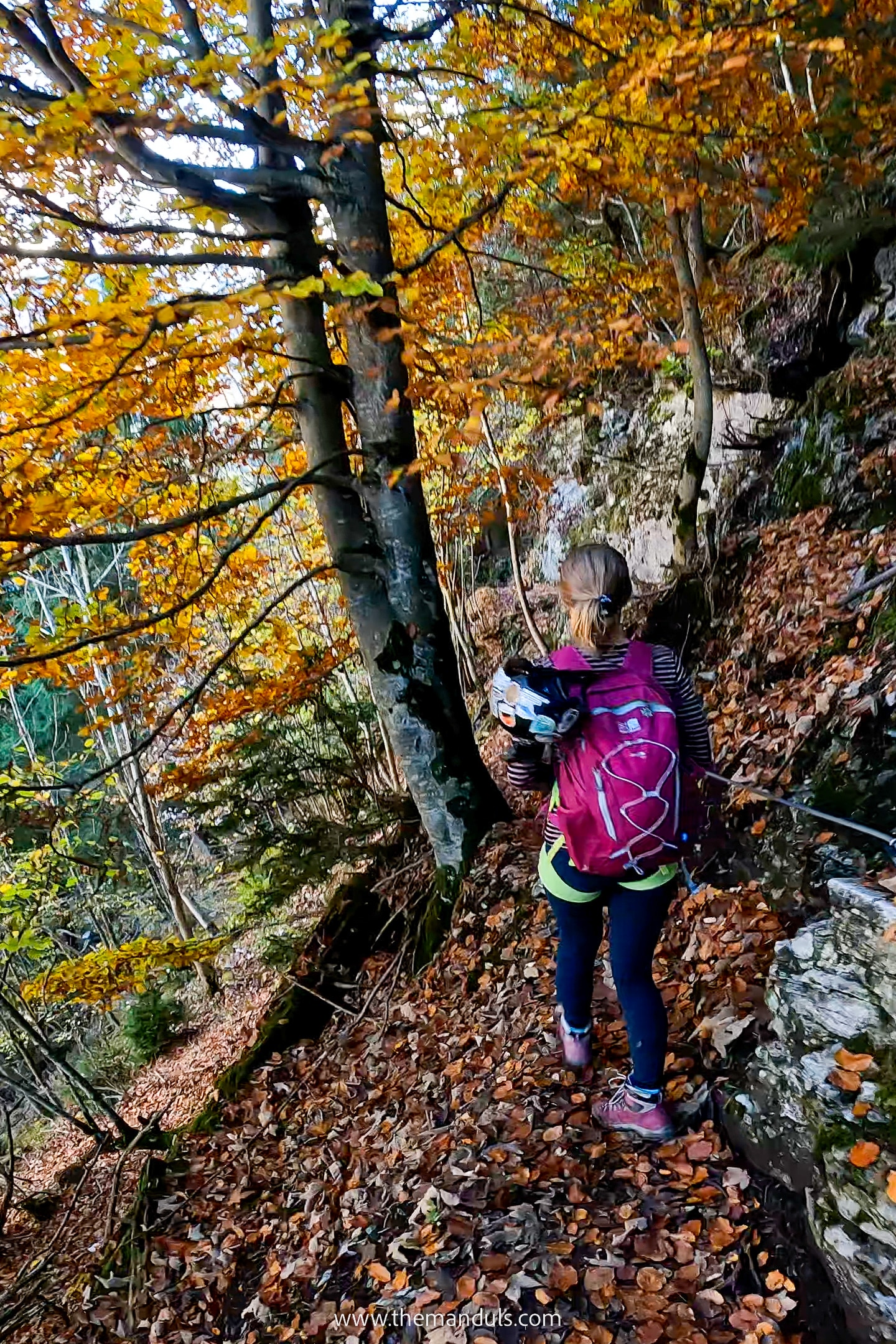
After passing through the tunnel at the entrance, we started descending through the forest. The route initially alternates between earthy paths, rocks and short secured sections, while the exposure increases gradually.
This first part felt much calmer than what followed and gave us time to get comfortable with the equipment. However, the ground was covered with wet leaves during our autumn visit, making some sections muddy and slippery.
Wherever the safety cable was available, we stayed clipped in. Even though this part is less exposed, it is still part of the via ferrata and conditions can make the descent more difficult than it looks.
After around 15 minutes, we reached the edge of the cliff and the first major exposed section of the route.
Walking along the cliff face
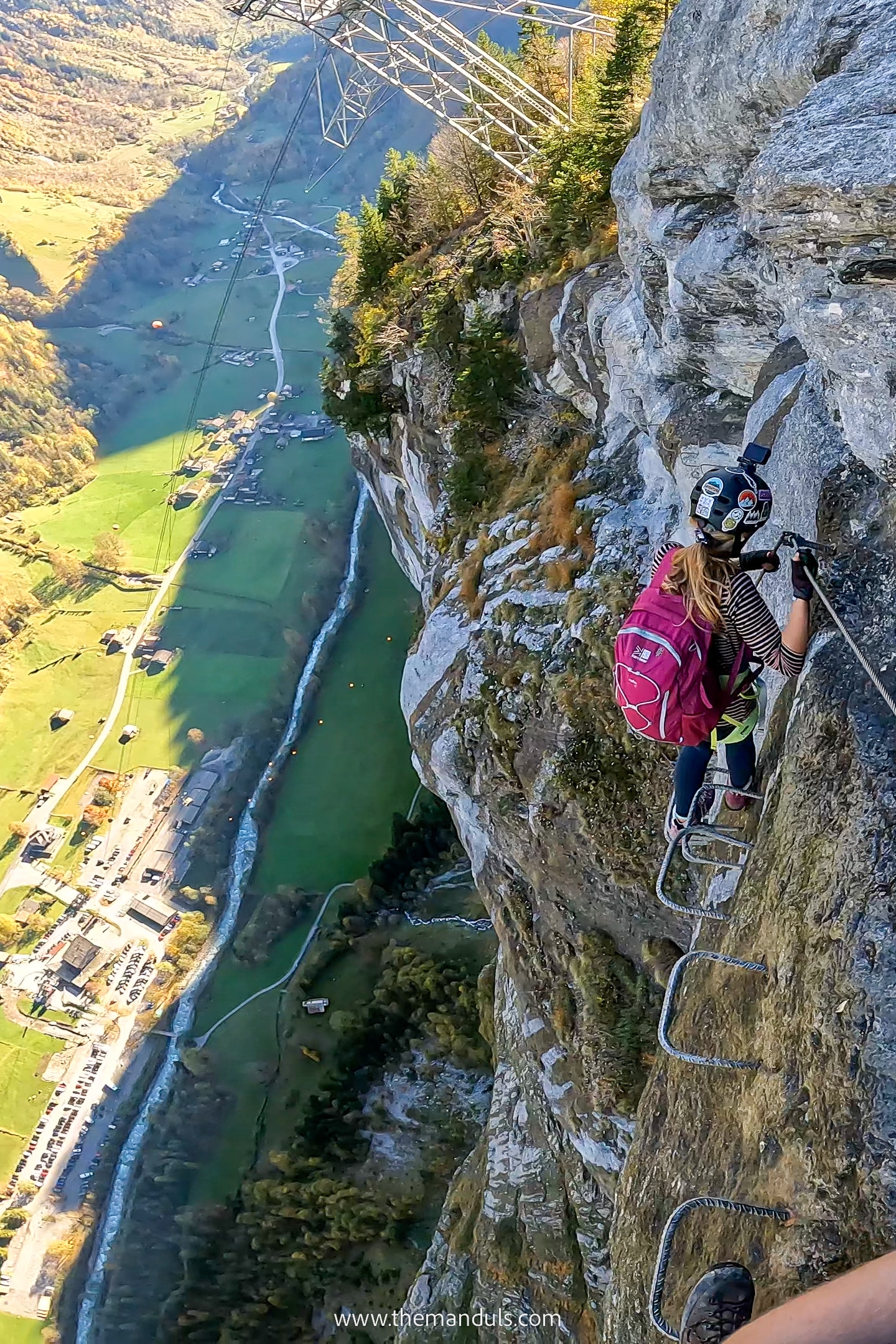
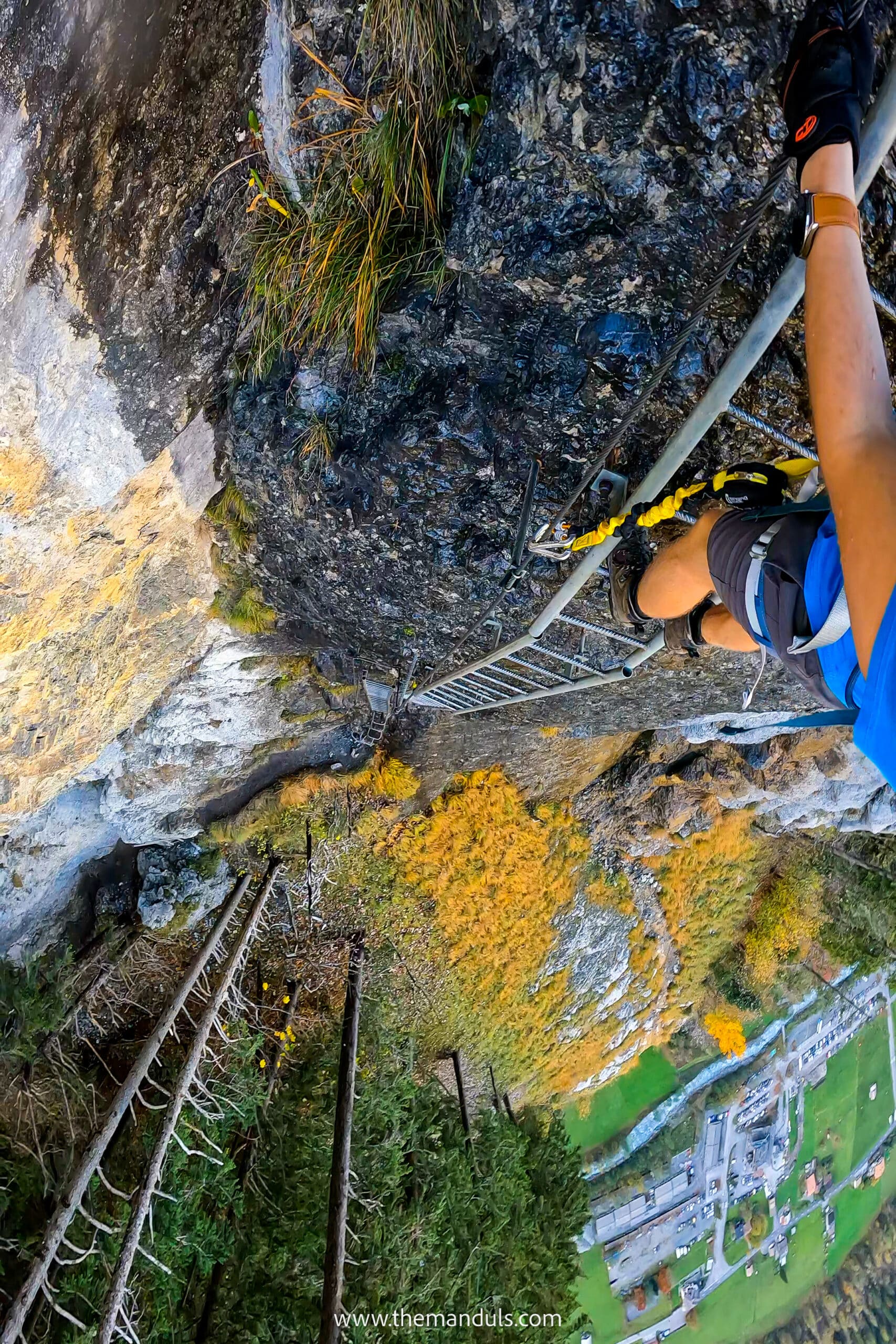
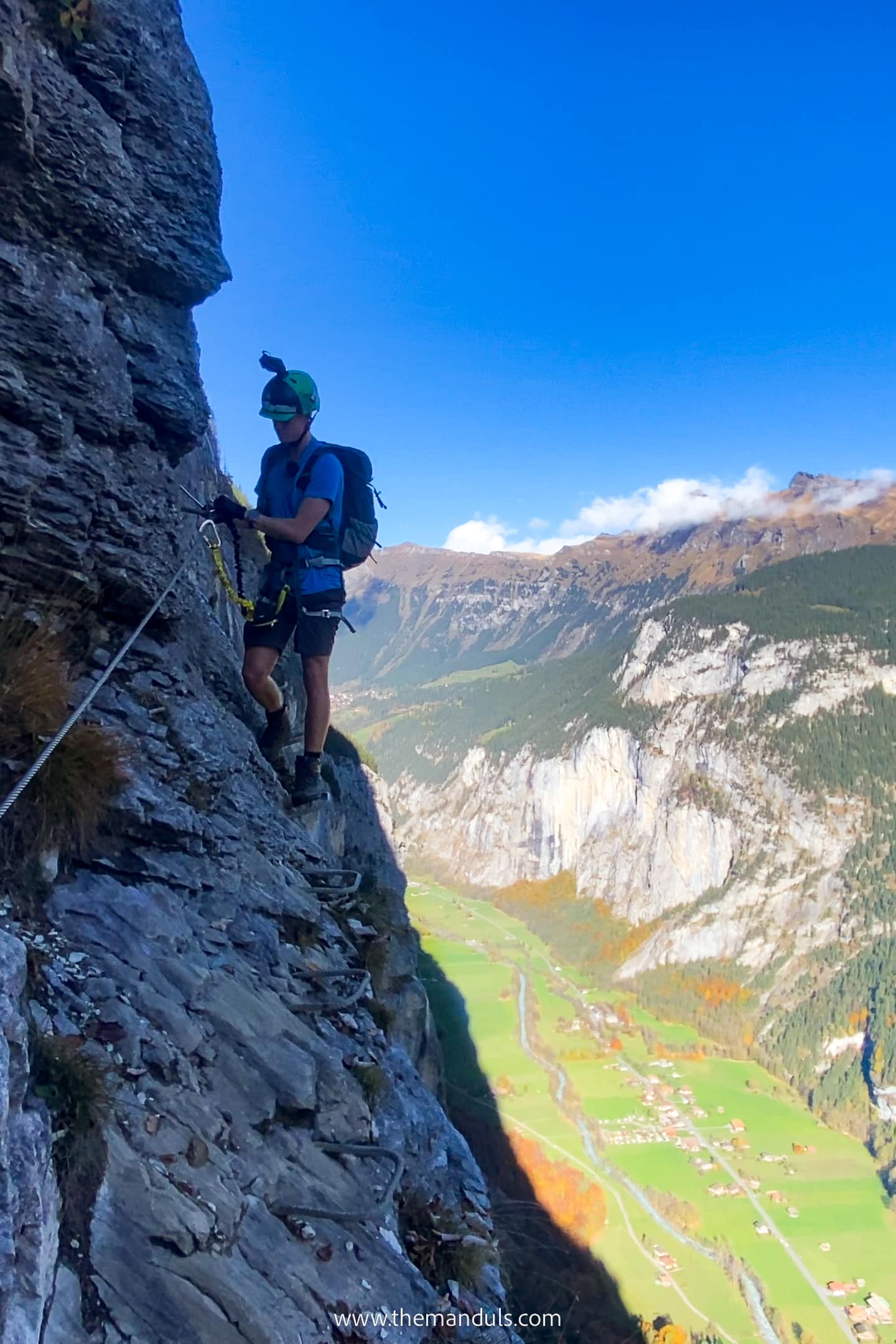
The first major highlight is the exposed traverse directly across the cliff. Once we saw the metal rungs disappearing around the rock face, the scale of the route suddenly felt very real.
Taking the first step was the hardest part for us. The rungs sit roughly 600 metres above the Lauterbrunnen Valley, and looking down made the exposure feel much greater than the K3 rating might suggest.
Our knees were shaking at first, even though we are normally comfortable with heights.

After a few steps, we settled into the movement and started enjoying the section more. Most of the rungs are positioned close together, but you still need to move carefully, stay clipped in and focus on each step.
The short downward sections felt more intimidating than the horizontal traverse. When descending, we had to look for the next rung below our feet while seeing the valley beneath us, which felt very different from climbing upwards.
The entire cliff traverse took us less than ten minutes. It was one of the shortest parts of the route, but also the section that stayed with us most.
Three-Cable Bridges
After another easier section through the forest, we reached the first three-cable bridge above Mürrenbach Falls. It consists of one cable for your feet and two higher cables that you can hold while staying attached to the safety line.
At first, we could not imagine how walking across a single cable would feel stable enough. Surprisingly, this section moved less than we expected, and once we found our balance, crossing it was more enjoyable than frightening.
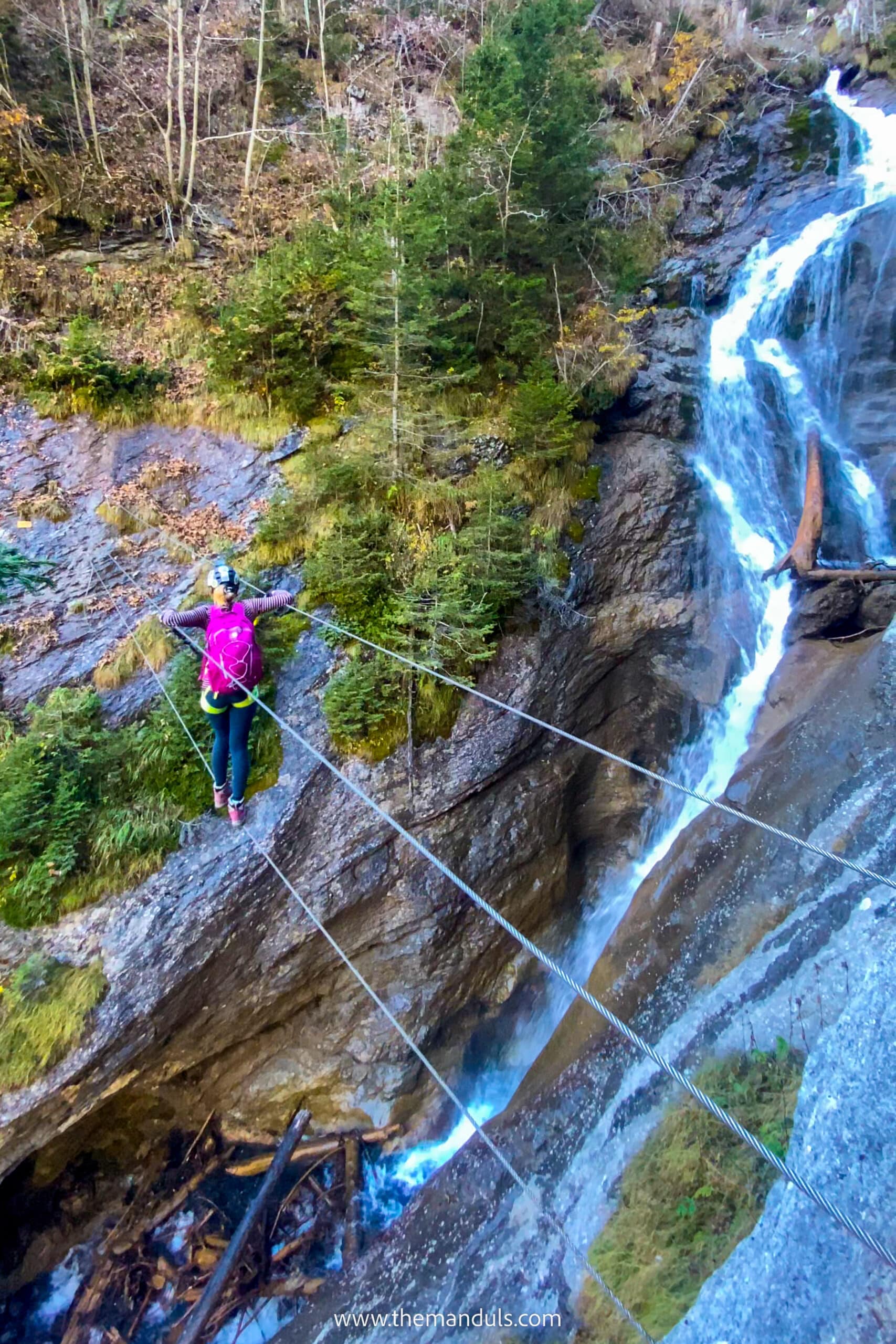
The setting makes it especially memorable. You cross directly above the stream, with the waterfall dropping towards the Lauterbrunnen Valley beside you.
Later in the route, there is a second, shorter three-cable bridge across a small gorge. Neither crossing felt as intimidating to us as the exposed cliff traverse or the final Nepal Bridge, but they still require balance and full concentration.
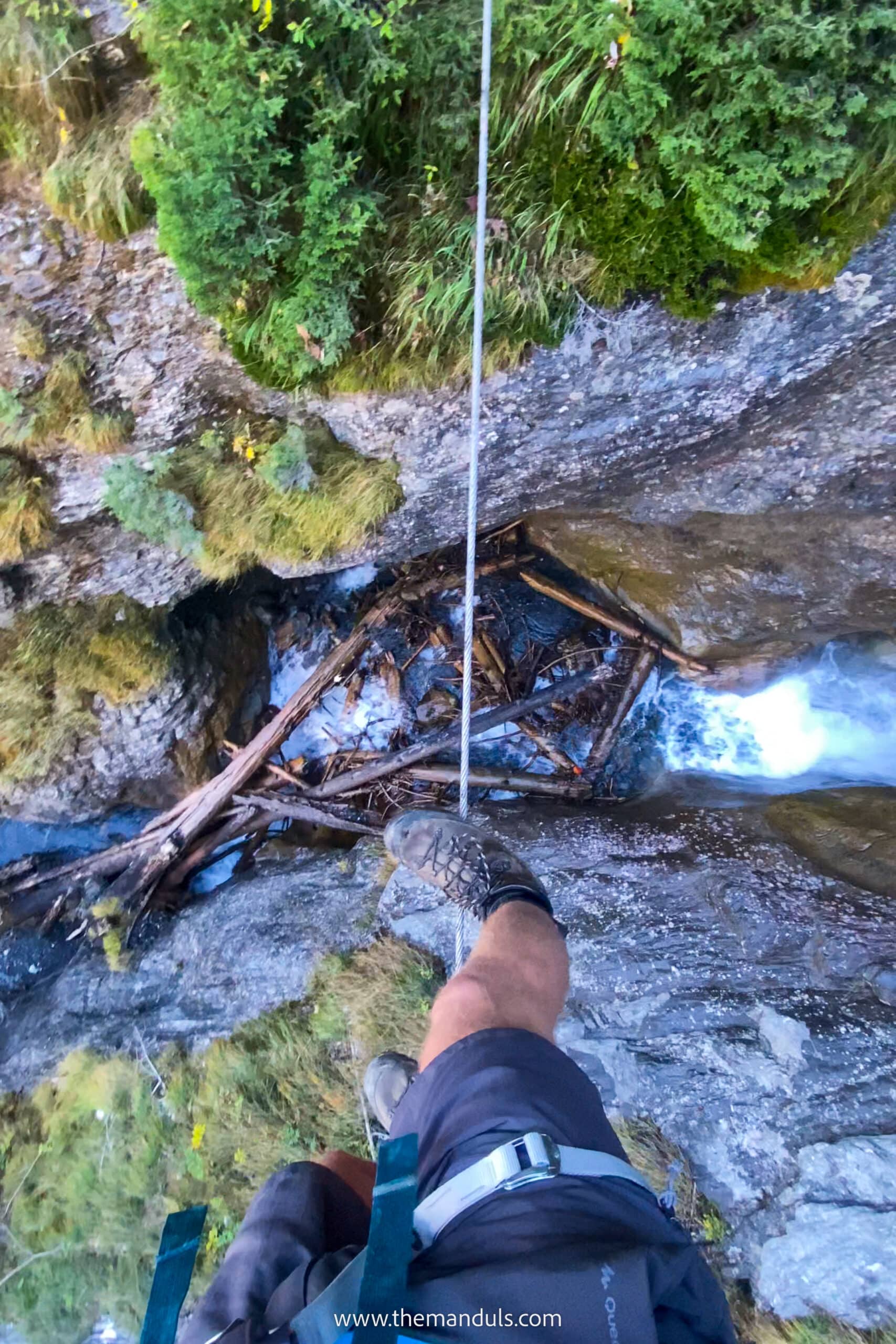
Zipline – Guided Tours Only
Above Mürrenbach Falls, the route splits briefly. Visitors completing the via ferrata independently continue across the three-cable bridge, while guided groups may cross the waterfall using the zipline.
The zipline remains locked and can only be used with an authorized mountain guide. You do not miss any essential part of the route by going independently, but the zipline is an extra feature included with the guided experience.
Ladders
After the waterfall crossings, the route returns to the forest and feels easier for a while. During our autumn visit, this section was covered in orange leaves, but the ground was also muddy and slippery in places.
Around halfway through the via ferrata, we reached a series of ladders leading further down towards Gimmelwald. Some were wet from the nearby streams, so we moved slowly and checked each foothold before shifting our weight.
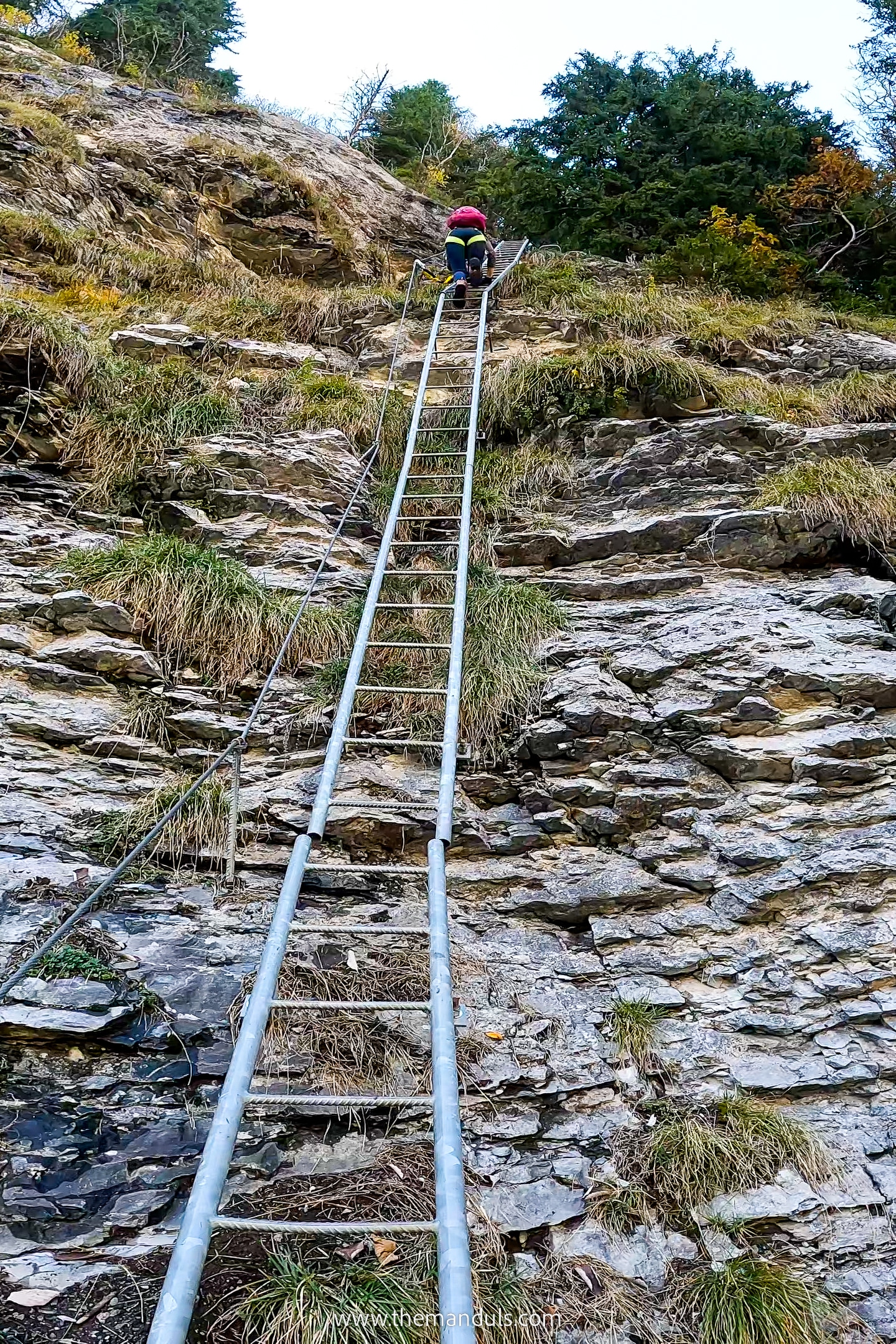
The ladders themselves did not feel technically difficult to us, but the exposure returns quickly. Several end beside narrow ledges with steep drops below, so this is not a section where we would relax completely.
Stay attached wherever the safety cable is available and leave enough space between you and the person ahead, especially on the longer ladders.
Nepal Bridge
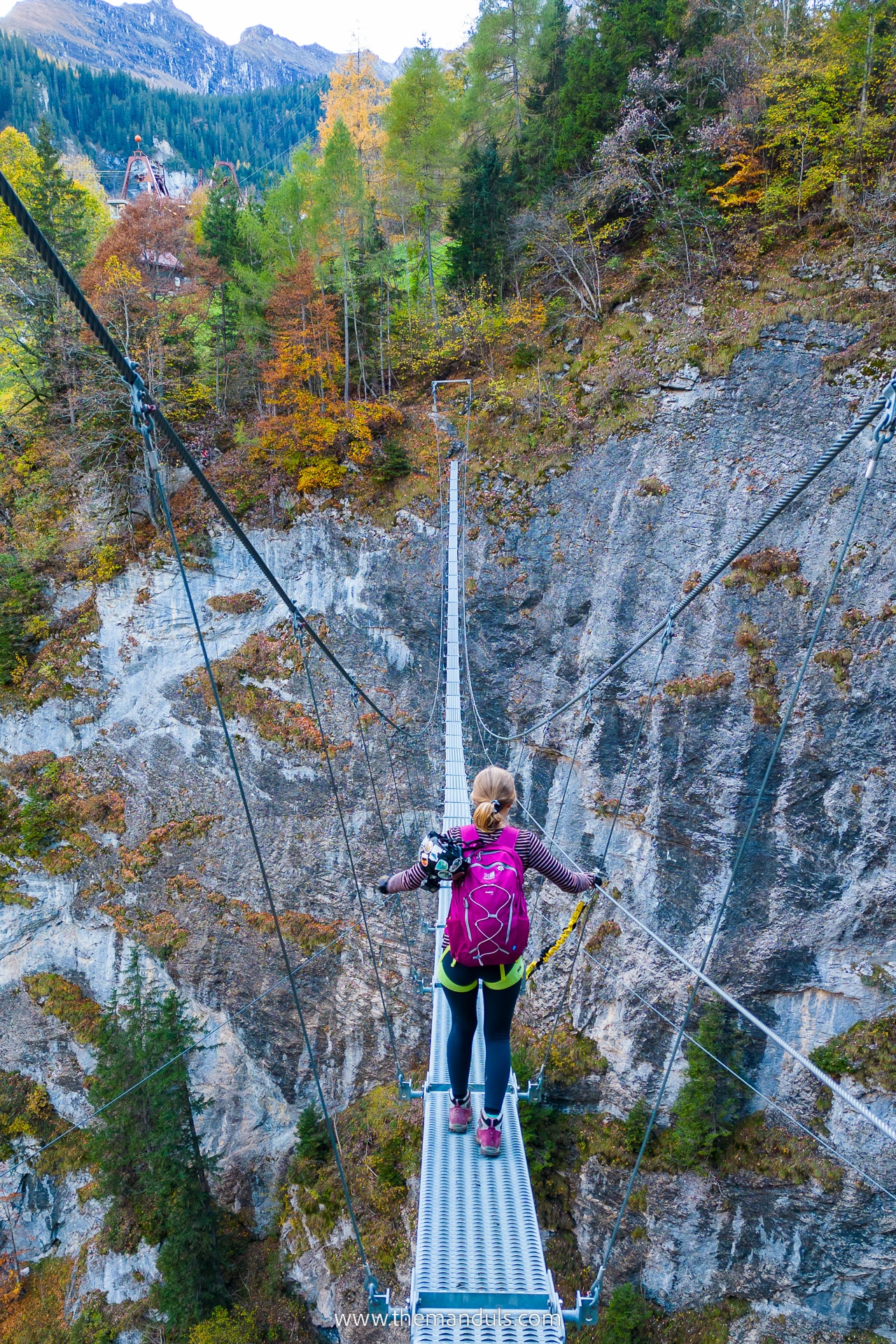
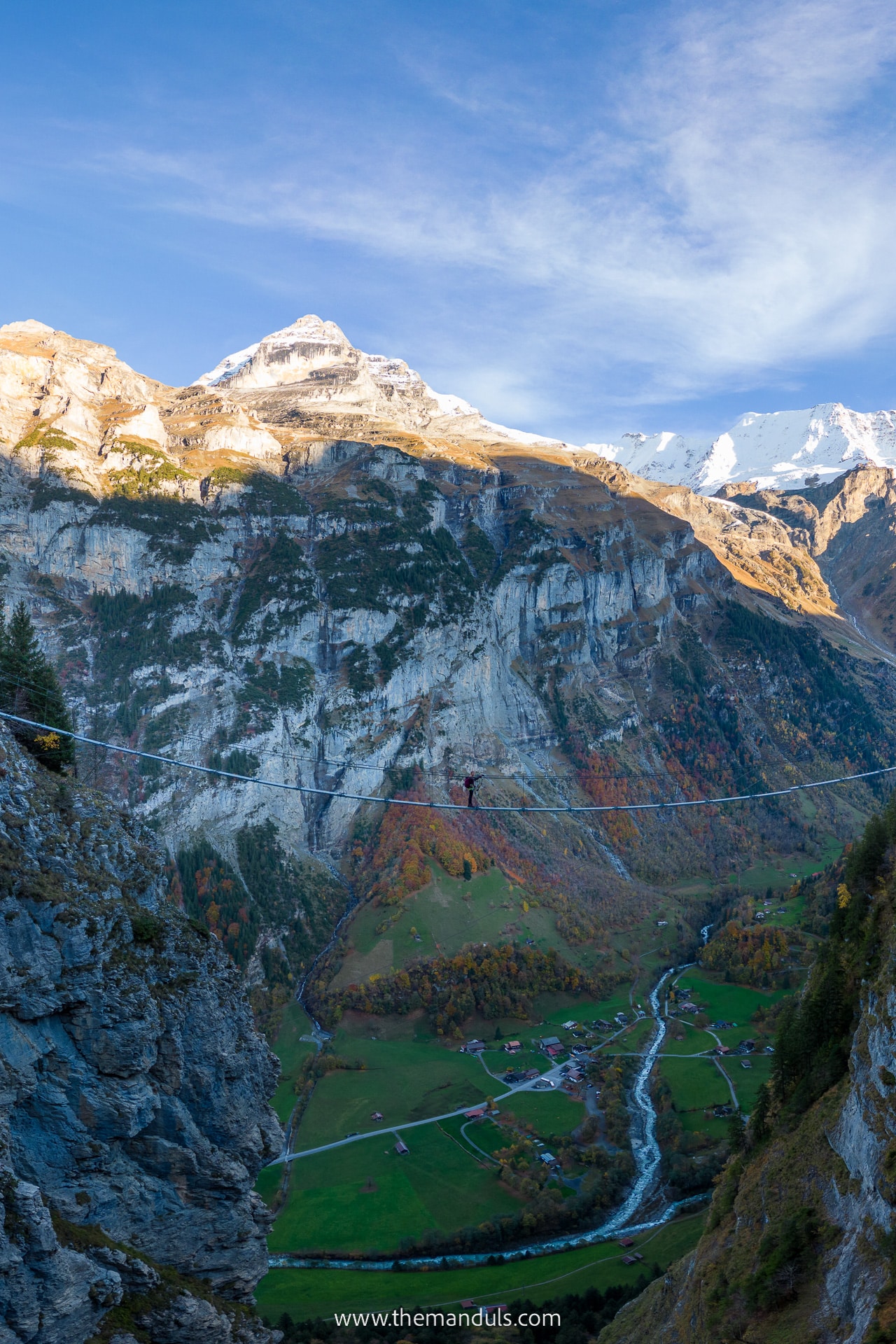
The final major feature is the 80-metre-long Nepal Bridge near Gimmelwald. From a distance, both ends appear to rise steeply, but the bridge feels much more level once you step onto it.
This was the section that made us hesitate the longest. We watched a family with two children cross before us, which gave us the confidence to follow, but the bridge still felt far less stable than the earlier cable crossings.
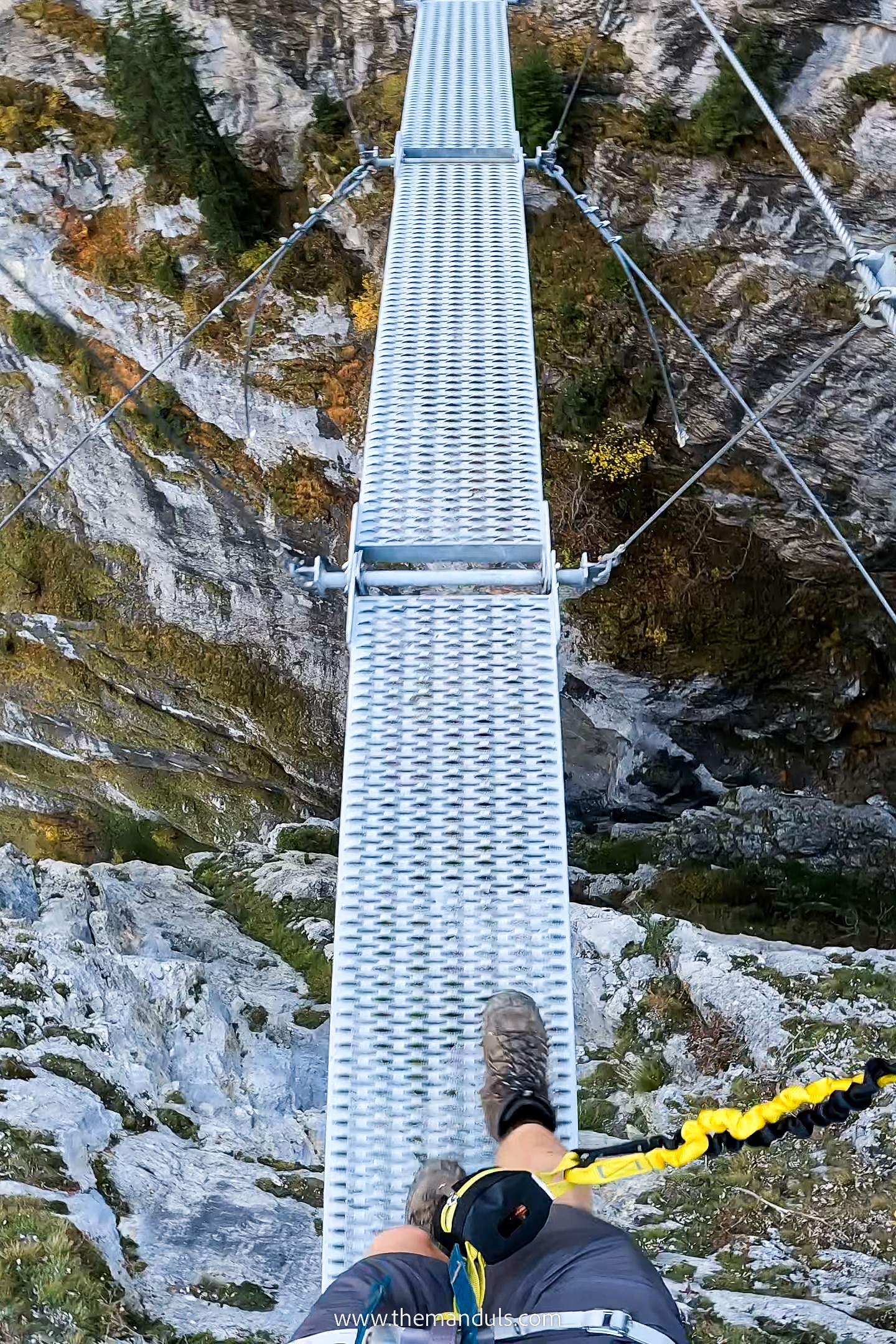
It moves from side to side and slightly up and down as people walk across. If you are nervous, wait until there is enough space between you and the person ahead, as every movement travels through the bridge.
There is no solid handrail, only the movable safety cable, so the crossing feels very exposed. Stay clipped in, move steadily and avoid rushing.
The bridge can be bypassed by following the marked exit towards the regular walking trail between Mürren and Gimmelwald. After crossing it, only a short uphill walk remains to reach Gimmelwald and the cable car station.
Best time for Via Ferrata Mürren
Via Ferrata Mürren is officially open from 1 June to 31 October, but the best conditions are usually between July and September. These months generally offer longer daylight, warmer temperatures and a lower chance of snow remaining on the route.
We completed the via ferrata in autumn and loved the orange and red foliage along the forest sections. However, fallen leaves made the muddy downhill terrain noticeably more slippery. The days are also shorter in October, so starting early becomes more important.
Always confirm that it is officially open before travelling to Mürren specifically for the ferrata.
More important than the month is the weather on the day. Do not attempt the route in rain, thunderstorms or when the rock, cables and forest paths are wet. Even if the ferrata is officially open, the rental shop may refuse to provide equipment when conditions are unsafe.
We would choose a dry morning with a stable forecast and avoid starting late in the day. The route may only be entered after 9 AM and must be completed by 6 PM.
Where to Stay in Mürren
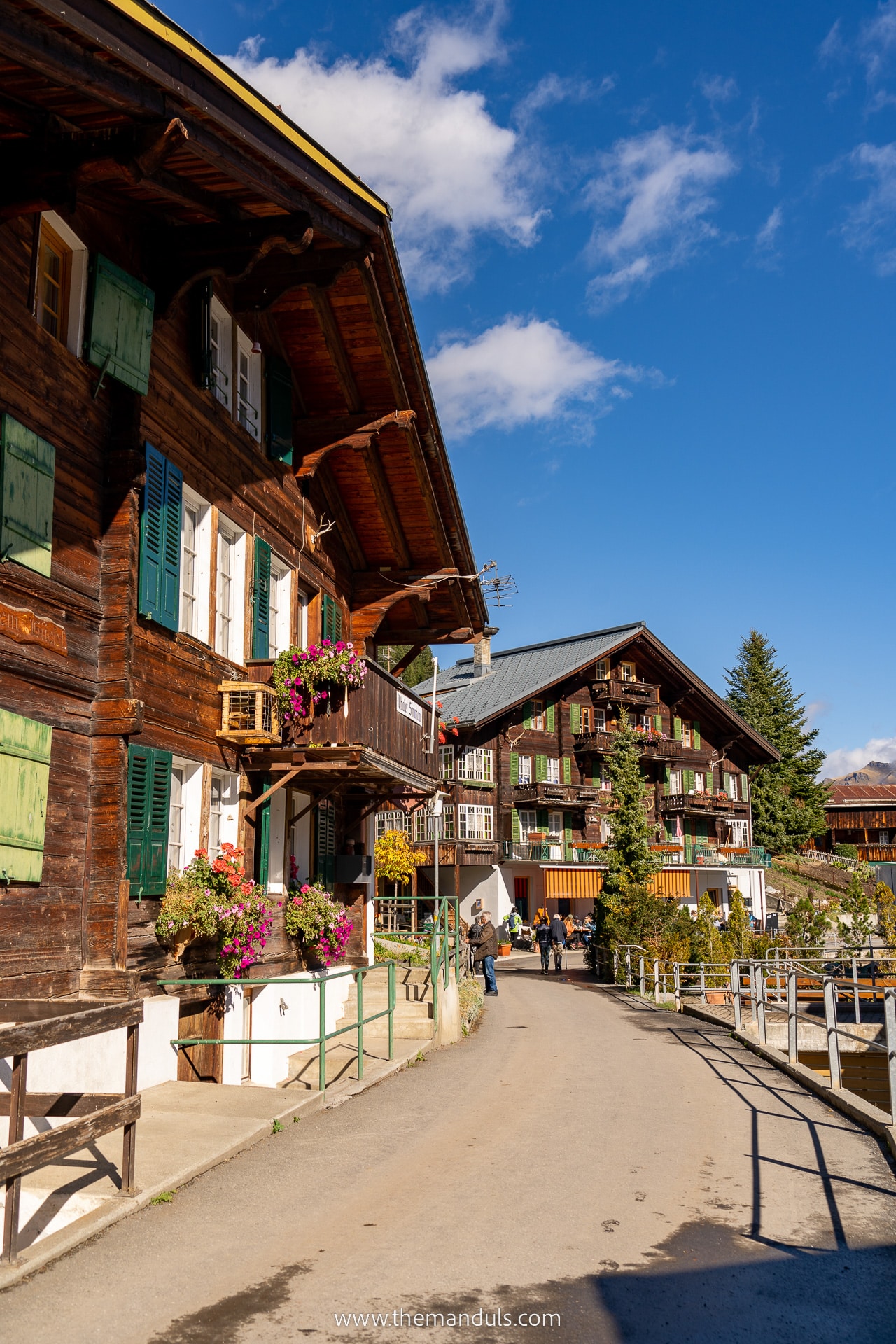
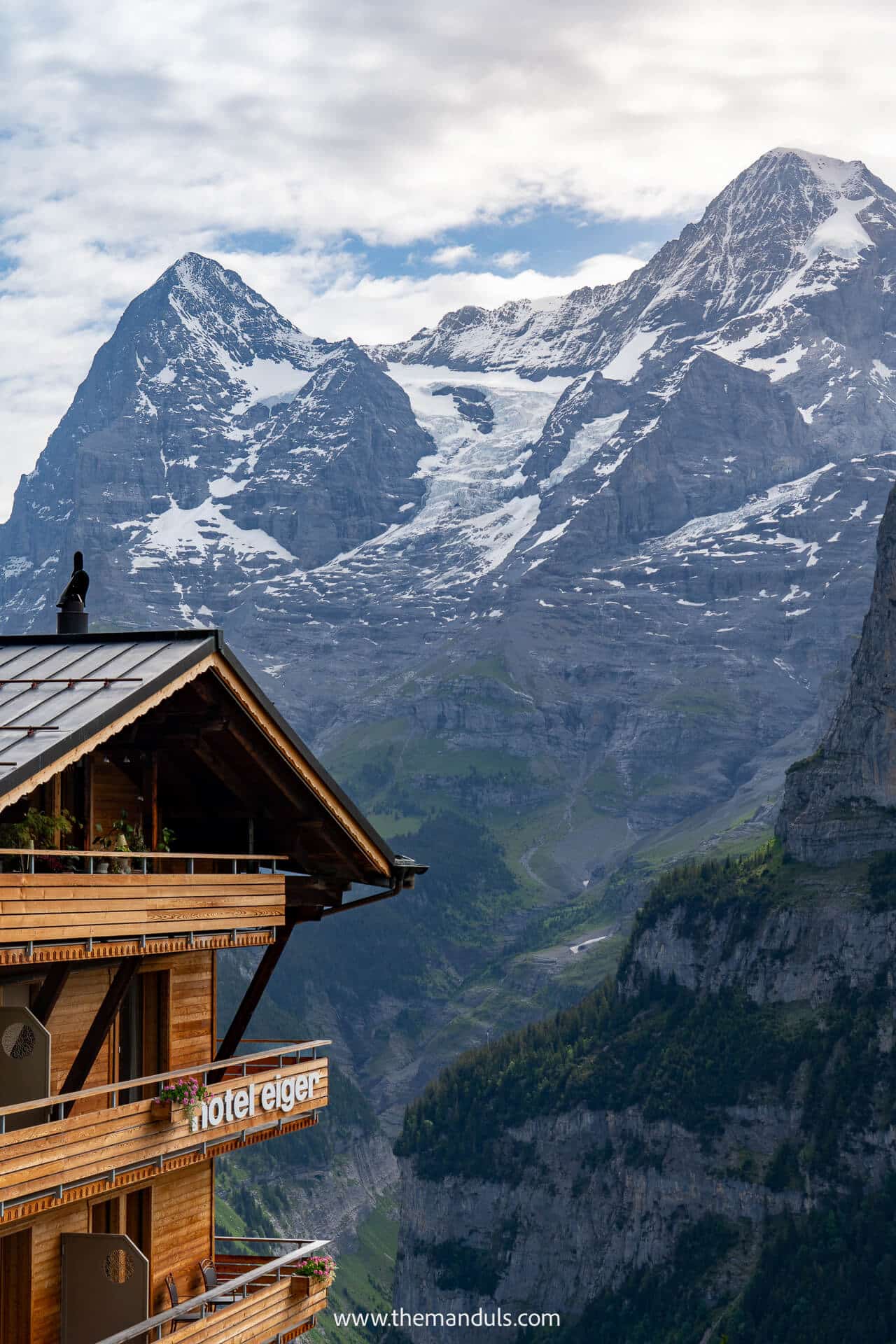
We stayed at Hotel Eiger Mürren and had the most amazing time. The breakfast buffet had an incredible selection, but our favorite part was the terrace with wide-open views of the surrounding mountains.
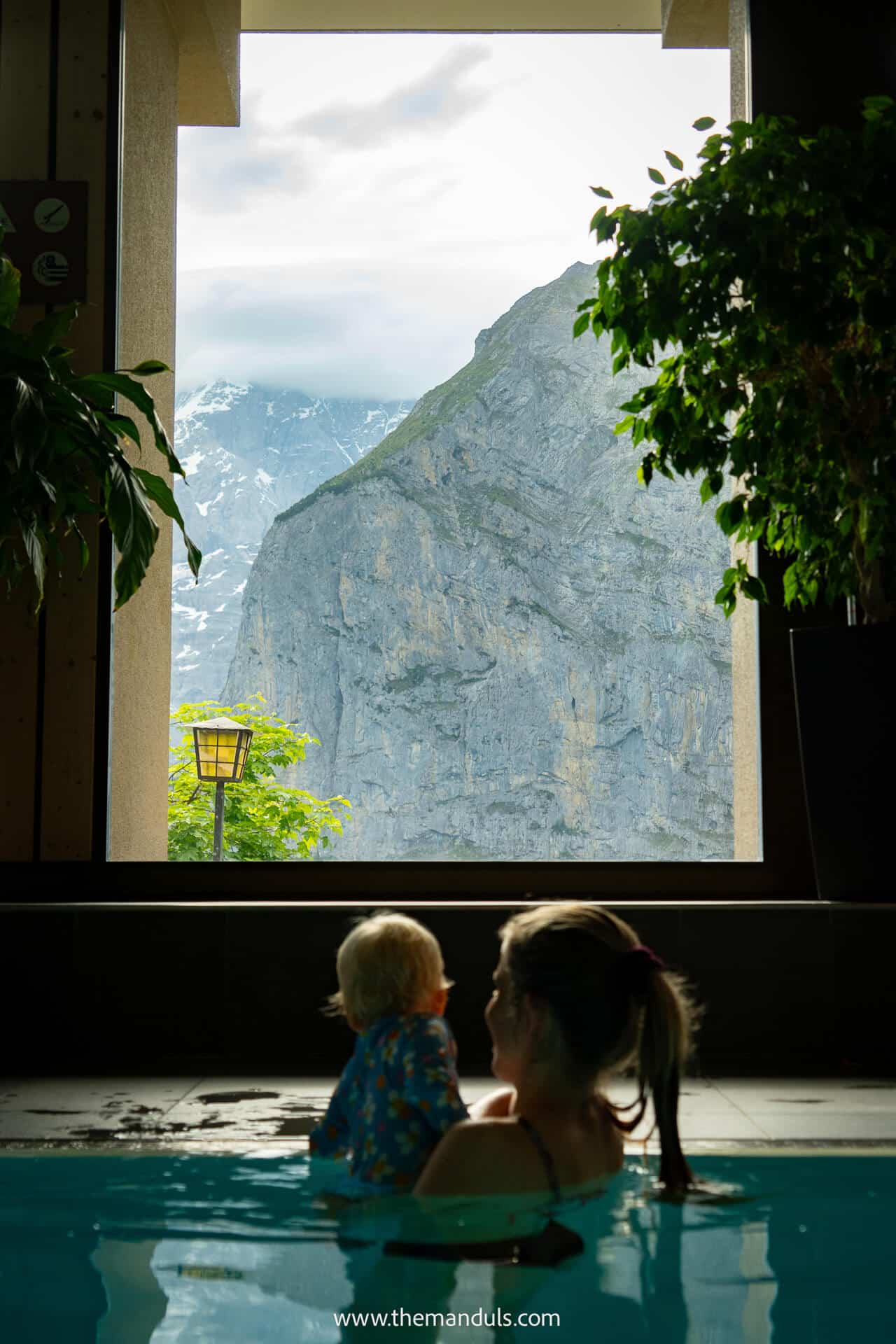
After hiking, we relaxed in the indoor pool overlooking the peaks and spent time in the hotel’s cozy spa area. We’d happily stay here again, especially if you want a comfortable place to recover after active days in the mountains.
Frequently Asked Questions
No. The route is officially open only from 1 June to 31 October, between 9 AM and 6 PM. Using it outside these dates is not permitted, even if the weather appears suitable.
Yes, there is no entrance fee for the route itself. However, you still need to pay for transport to Mürren, equipment rental if you do not have your own set, and an optional guide. A helmet, harness and via ferrata set currently cost CHF 35 to rent.
Plan around 3–4 hours for the full route from Mürren to Gimmelwald. Experienced visitors may complete it faster, but exposure, other groups and slippery terrain can slow you down.
It can be suitable as a first via ferrata with a qualified guide. We would not recommend doing it independently if you have never used via ferrata equipment or do not know how you react to strong exposure.
Children and teenagers need enough height and reach to use the cables and metal rungs safely, as well as the confidence to complete several highly exposed sections. Minors renting equipment must be accompanied by an adult or provide the required consent form. For younger or inexperienced children, we would only consider the route with a guide.
Wear comfortable outdoor clothing that allows you to move freely, together with sturdy hiking or approach shoes with a grippy sole. Bring an extra layer because parts of the route remain shaded, and we strongly recommend gloves to protect your hands on the cables and ladders.
Where to eat
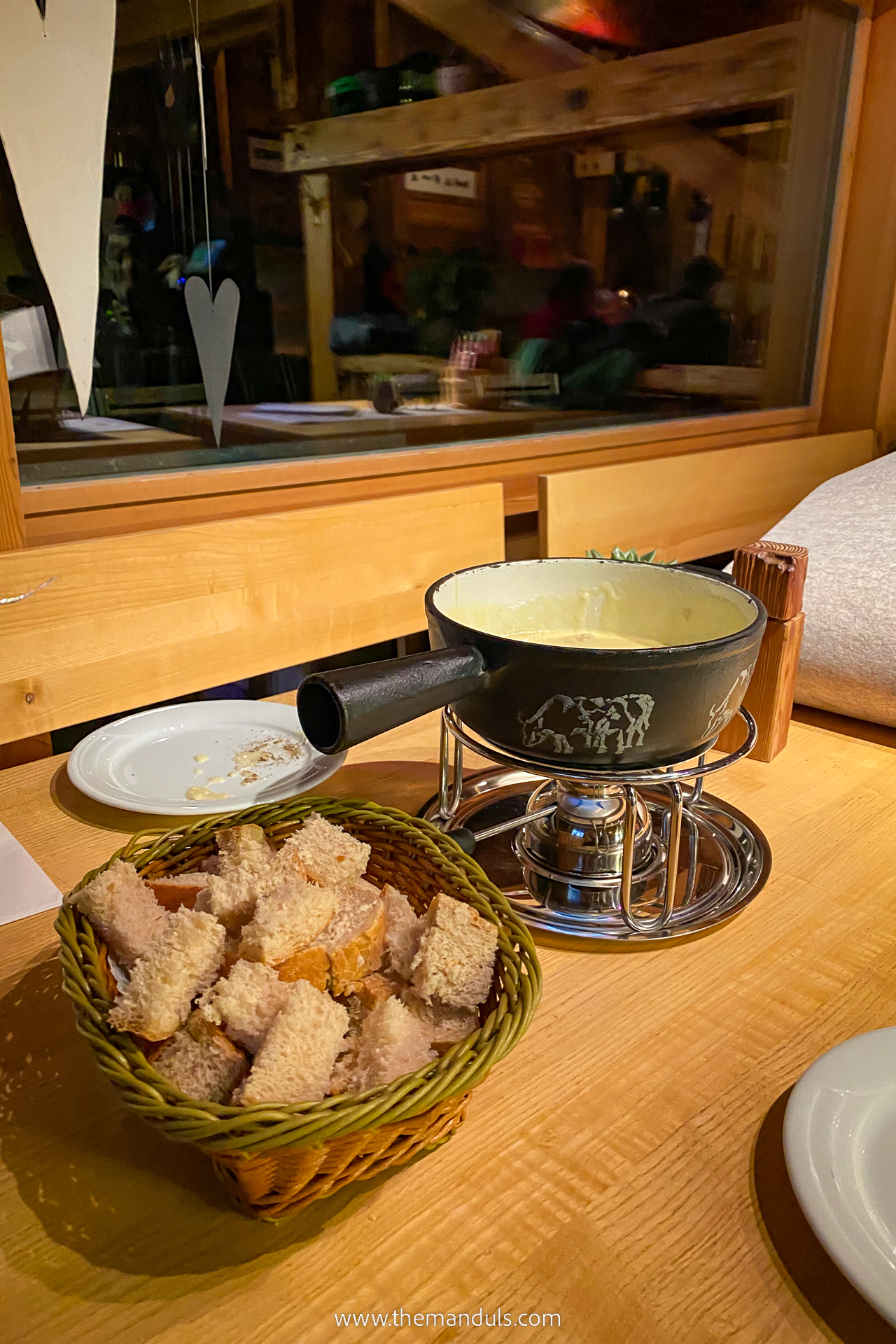
- Restaurant Stägerestübli – Traditional meals with great views. Try raclette, spätzli, or rösti here.
- Café LIV – A perfect place for a coffee stop with some cake. They also sell tasty sandwiches.
- Tham’s Snack – An authentic Asian food which is cooked to perfection and extremely scrumptious.
Final thoughts on Via Ferrata Mürren
Via Ferrata Mürren was one of the most memorable mountain activities we did in Switzerland. It is not the most physically demanding ferrata, but the cliff traverse and Nepal Bridge make it far more exposed than the K3 rating may suggest.
We would recommend it to sure-footed hikers who are comfortable with heights and already know how to use via ferrata equipment. If this would be your first ferrata, joining a guided tour is the better choice.
We would happily do the route again, but only in dry, stable weather. If strong exposure makes you panic rather than simply nervous, we would skip it — the views are impressive, but you need enough confidence to move safely and enjoy the experience.
Thank You So much for providing detailed information. Looking forward to trying it
Have fun! 🙂
Wow, what a description..
You definitely left me wanting to visit.
Congratulations
This place will leave you in awe! You definitely need to go there at least once in your life ❤️ We wish you happy travels and thanks for the comment 😊